
- July 30, 2026
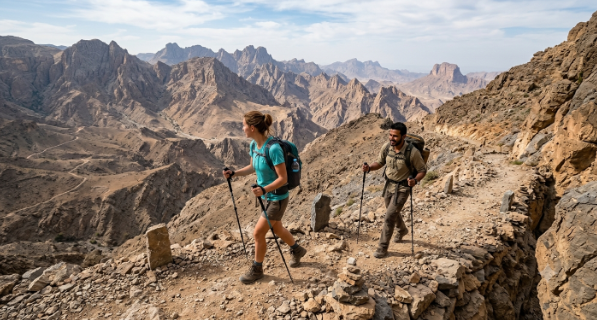
When people think of the Middle East, they picture deserts, heat and ancient cities. Few picture mountains. Yet the region holds some of the most dramatic hiking country anywhere, with peaks rising past 3,000 metres, deep canyons and stone villages older than memory. More UK travellers are discovering this every year. Many are pilgrims who book All Inclusive Umrah Packages for the holy cities, then add a few days on a tourist e-Visa to see the mountains too. If that sounds like your kind of trip, here are five of the best trails in the region, and how to plan them from the UK.
what are the best hiking spots in the Middle East?
The best-known mountain destinations in the Middle East are Jebel Sawda in Saudi Arabia’s Asir region, Wadi Rum in Jordan, Jebel Shams in Oman, the sandstone peaks of AlUla in Saudi Arabia, and Jebel Hafeet in the UAE. The best months to hike are October to March, when the weather is cool.
1. Jebel Sawda, Saudi Arabia the roof of the Kingdom
Jebel Sawda sits in the Asir National Park near the city of Abha, in the far south-west of Saudi Arabia. At around 3,000 metres, it is often described as the highest point in the Kingdom. The trails here pass terraced hillsides, juniper forests and steep escarpments, and the views over the valleys below are worth every step.
Abha makes a good base. It has comfortable hotels, cooler air than the rest of the country and local guides who know the paths well. Two things to know before you go: the area is famous for its baboons, so keep food packed away, and the weather changes fast at height, so bring a warm layer even in summer.
2. Wadi Rum, Jordan the Valley of the Moon
Wadi Rum is not in Saudi Arabia, and it is not a single peak. It is a vast desert valley in southern Jordan, close to the Saudi border, and a UNESCO World Heritage Site. Red cliffs and rock towers rise straight out of the sand, which is why film crews use it to play the surface of Mars.
Local Bedouin guides lead the way here, and going with them is half the experience. You can hike, climb the rock faces, ride camels, take a jeep safari through the dunes and sleep in a desert camp under some of the clearest night skies on earth. Jordan’s highest mountain, Jabal Umm ad Dami, stands at the southern edge of the protected area for those who want a proper summit day.
3. Jebel Shams, Oman the Grand Canyon of Arabia
Jebel Shams is Oman’s highest mountain, and the great canyon beside it, Wadi Ghul, has earned the nickname “the Grand Canyon of Arabia”. The most famous route is the Balcony Walk, a path that runs along a ledge on the canyon wall. It sounds frightening, but it is a steady, well-walked trail with views that stay with you for life.
The path passes an abandoned stone village built into the cliff face, a quiet reminder of how people lived in these mountains for centuries. Go early in the morning, carry plenty of water and give yourself time to simply sit and look.
4. AlUla and Hegra, Saudi Arabia desert peaks and ancient tombs
AlUla is the jewel of north-west Saudi Arabia. Huge sandstone cliffs, strange rock formations and a green oasis valley sit side by side, and the hiking trails wind between them. Next door is Hegra, once a city of the ancient Nabataean Kingdom, where more than a hundred tombs were carved straight into the rock some two thousand years ago. It was Saudi Arabia’s first UNESCO World Heritage Site.
AlUla is the easiest add-on for pilgrims, because it sits within reach of Madinah. Many families who book Umrah Packages from Manchester now ask their agency to add two or three days in AlUla after the pilgrimage. You fly from Manchester, complete your Umrah in Makkah and Madinah, and then see one of the wonders of the ancient world before you fly home. One trip, two journeys.
5. Jebel Hafeet, UAE the desert giant
Jebel Hafeet rises about 1,240 metres out of the flat desert near Al Ain, on the border between the UAE and Oman. Locals call it the desert giant, and you can see why: there is nothing else like it for miles. A winding mountain road takes you most of the way up, and short trails lead to viewpoints over the sands below.
The mountain matters for history too. At its base, archaeologists found ancient tombs around five thousand years old, from the early Bronze Age. So a sunset visit here gives you two views at once: the desert stretching to the horizon, and a burial ground older than the pyramids.
Planning your trip from the UK
Travel to the region has never been easier. Direct flights leave London, Manchester and Birmingham for Jeddah, Riyadh, Amman, Muscat and Dubai. Saudi Arabia’s tourist e-Visa covers both Umrah and sightseeing, lasts up to 90 days and can be arranged online in a few days, usually through the same agency that books your flights and hotels.
A few simple rules for the mountains themselves: hike between October and March when the heat drops, start early in the day, carry more water than you think you need, wear proper walking shoes, and take a local guide on any trail you do not know. Dress modestly, as you would anywhere in the region.
Explore AJK Tours to find the best Tour packages!!
Common questions
Do I need a special visa to go hiking in Saudi Arabia?
No. The standard tourist e-Visa covers sightseeing and hiking, and it can be used for Umrah as well.
Can I combine Umrah with a hiking trip?
Yes. Many UK pilgrims complete Umrah first, then visit AlUla, Taif or the Asir mountains afterwards on the same visa.
What is the best time of year for hiking in the Middle East?
October to March. Summer temperatures are dangerous for long hikes in most of the region.
Are the trails safe for beginners?
Trails like the Balcony Walk and Jebel Hafeet’s viewpoints suit most fitness levels. Bigger climbs, such as Jabal Umm ad Dami, need a guide and a reasonable level of fitness.
Final thoughts
The Middle East is far more than sand. From the juniper forests of Asir to the canyon ledges of Oman, the region rewards anyone willing to lace up a pair of boots. And if your journey begins with Umrah, even better: finish your worship, then go and see the mountains that have watched over these lands for thousands of years. Plan for the cool months, book early, and travel safe.
Comments