
- October 16, 2026
Umrah is one of the most beautiful acts of worship a Muslim can perform. It takes only a few hours to complete, yet many pilgrims remember it for the rest of their lives. If this is your first trip, it is normal to feel unsure about what to do and what to say.
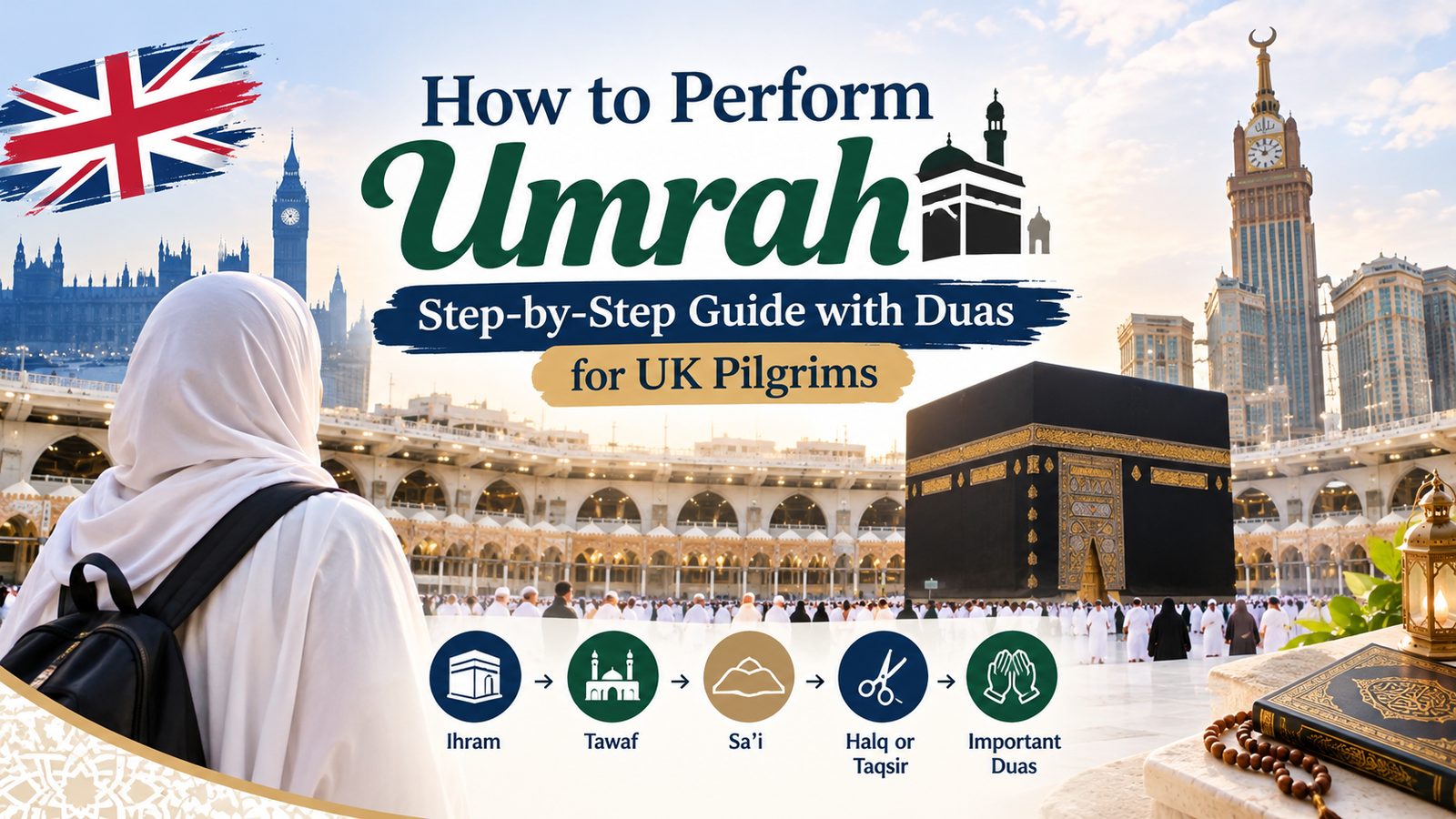
This guide explains how to perform Umrah step by step, from wearing Ihram to the final haircut. It includes the Talbiyah, the most important Umrah duas, and a practical Umrah checklist for pilgrims travelling from the UK.
Umrah Steps at a Glance
Umrah has four main steps. Everything else in this guide supports them.
| Step | What you do | Where |
| 1. Ihram | Make the intention, wear Ihram and recite the Talbiyah | Before crossing the Miqat |
| 2. Tawaf | Walk around the Kaaba seven times | Masjid al-Haram |
| 3. Sa’i | Walk seven times between Safa and Marwah | Mas’a, inside Masjid al-Haram |
| 4. Halq or Taqsir | Shave or trim the hair | After Sa’i |
Once you complete step 4, your Umrah is done and the restrictions of Ihram end.
Step 1: Ihram and the Talbiyah
Ihram is the sacred state a pilgrim enters before Umrah. It starts with a clear intention (niyyah) and must be entered before you cross the Miqat, the boundary point around Makkah.
For UK pilgrims: most flights from London, Manchester or Birmingham to Jeddah pass the Miqat in the air. Many pilgrims put on Ihram clothing at home or at the airport, then make the intention on the plane when the crew announces the Miqat. If you fly to Madinah first, you will enter Ihram later at Dhul Hulayfah (Masjid Miqat) on the way to Makkah.
How to enter Ihram:
- Trim nails, remove unwanted hair and take a full bath (ghusl).
- Men wear two plain, unstitched white sheets. Women wear modest everyday clothing; the face and hands stay uncovered.
- Pray two rak’ahs if it is not a disliked time.
- Make the intention for Umrah: Labbayk Allahumma Umrah (O Allah, here I am for Umrah).
- Begin reciting the Talbiyah.
The Talbiyah (Arabic, Transliteration and Meaning)
لَبَّيْكَ اللَّهُمَّ لَبَّيْكَ، لَبَّيْكَ لَا شَرِيكَ لَكَ لَبَّيْكَ، إِنَّ الْحَمْدَ وَالنِّعْمَةَ لَكَ وَالْمُلْكَ، لَا شَرِيكَ لَكَ
Labbayk Allahumma labbayk, labbayk la sharika laka labbayk, innal-hamda wan-ni’mata laka wal-mulk, la sharika lak.
“Here I am, O Allah, here I am. Here I am, You have no partner, here I am. All praise, blessings and sovereignty belong to You. You have no partner.” (Sahih al-Bukhari 1549)
Men recite the Talbiyah aloud; women recite it quietly. Keep repeating it until you begin Tawaf.
Things to avoid in Ihram: perfume, cutting hair or nails, hunting, marital relations, and arguing. Men must not cover the head or wear stitched clothing; women must not wear a niqab or gloves.
Step 2: Tawaf Around the Kaaba
When you first see the Kaaba, take a moment. It is a time to make sincere dua for yourself and your family.
How to perform Tawaf:
- Start at the corner of the Black Stone (Hajar al-Aswad). Face it, raise your right hand and say Bismillahi Allahu Akbar.
- Walk anti-clockwise around the Kaaba, keeping it on your left.
- Complete seven circuits, each starting and ending at the Black Stone.
- Men uncover the right shoulder during Tawaf (idtiba) and walk briskly in the first three circuits (raml) if there is space.
Tawaf Dua
There is no fixed dua for each circuit. You can make dua in any language, recite the Quran or remember Allah. Between the Yemeni Corner and the Black Stone, it is Sunnah to recite:
رَبَّنَا آتِنَا فِي الدُّنْيَا حَسَنَةً وَفِي الْآخِرَةِ حَسَنَةً وَقِنَا عَذَابَ النَّارِ
Rabbana atina fid-dunya hasanah, wa fil-akhirati hasanah, wa qina ‘adhaban-nar.
“Our Lord, give us good in this world and good in the Hereafter, and protect us from the punishment of the Fire.” (Surah Al-Baqarah 2:201; Sunan Abu Dawud 1892)
After Tawaf: pray two rak’ahs behind Maqam Ibrahim if possible (or anywhere in the mosque). It is Sunnah to recite Surah Al-Kafirun in the first rak’ah and Surah Al-Ikhlas in the second. Then drink Zamzam water.
Step 3: Sa’i Between Safa and Marwah
Sa’i remembers Hajar (may Allah be pleased with her), who ran between these two hills searching for water for her son Isma’il.
How to perform Sa’i:
- Go to Safa and recite: Innas-Safa wal-Marwata min sha’a’irillah (Surah Al-Baqarah 2:158).
- Face the Kaaba, raise your hands, say Allahu Akbar three times and make dua.
- Walk to Marwah. That is one lap. Walking back to Safa is the second lap.
- Complete seven laps, finishing at Marwah.
- Men jog lightly between the two green lights; women walk normally.
Sa’i Dua
At Safa and Marwah, the Prophet ﷺ said:
لَا إِلَهَ إِلَّا اللَّهُ وَحْدَهُ لَا شَرِيكَ لَهُ، لَهُ الْمُلْكُ وَلَهُ الْحَمْدُ وَهُوَ عَلَى كُلِّ شَيْءٍ قَدِيرٌ
La ilaha illallahu wahdahu la sharika lah, lahul-mulku wa lahul-hamdu wa huwa ‘ala kulli shay’in qadir.
“There is no god but Allah alone, with no partner. His is the dominion and His is the praise, and He has power over all things.” (Sahih Muslim 1218)
During the laps, you may make any dua or remembrance you like.
Step 4: Halq or Taqsir (Shaving or Trimming)
To leave Ihram, men either shave the whole head (halq, which is better) or trim the hair evenly all over (taqsir). Women cut about a fingertip’s length from the end of their hair.
Your Umrah is now complete. Alhamdulillah. Many families send greetings to returning pilgrims; if you want ideas, here are some beautiful Umrah Mubarak wishes and duas to share.
Umrah Duas: A Quick List to Save on Your Phone
| Moment | Dua or dhikr |
| After making intention | Talbiyah: Labbayk Allahumma labbayk… |
| Starting each Tawaf circuit | Bismillahi Allahu Akbar |
| Between Yemeni Corner and Black Stone | Rabbana atina fid-dunya hasanah… |
| At Safa and Marwah | La ilaha illallahu wahdahu la sharika lah… |
| Drinking Zamzam | Any personal dua (Zamzam is for whatever it is drunk for) |
Tip: many pilgrims worry about reciting Arabic correctly. If you want to read these duas and the Quran with confidence before you travel, consider short online Quran classes for adults in the UK a few weeks before your trip.
Umrah Checklist for UK Pilgrims
Documents
- Passport valid for at least six months
- Saudi visa (UK citizens can usually apply for an eVisa that allows Umrah)
- Umrah permit through the Nusuk app, if required for your dates
- Travel insurance and hotel bookings
- Meningitis ACWY vaccination certificate, if your visa type requires it
Packing
- Two Ihram sheets for men (plus a spare) and a safety pin or Ihram belt
- Unscented soap, shampoo and deodorant for the Ihram period
- Comfortable sandals and a small bag for shoes in the mosque
- A pocket dua card or the list above on your phone
- Reusable water bottle for Zamzam
Visa and permit rules change often, so always check the latest requirements with the Saudi authorities or your travel agent before booking.
Common Umrah Mistakes to Avoid
- Crossing the Miqat without Ihram. Make the intention before your flight passes the Miqat.
- Believing each Tawaf circuit needs a special dua. Any sincere dua is acceptable.
- Starting Sa’i at Marwah. Sa’i always begins at Safa and ends at Marwah.
- Trimming only a few hairs. Men should trim evenly across the head.
- Pushing to touch the Black Stone. Pointing towards it is enough and avoids harming others.
Frequently Asked Questions
How long does it take to perform Umrah? Most pilgrims complete Umrah in 3 to 6 hours, depending on crowds. Tawaf and Sa’i take the longest.
What is the Talbiyah? The Talbiyah is the declaration pilgrims recite after entering Ihram: Labbayk Allahumma labbayk… It is repeated until Tawaf begins.
Are there specific duas for each round of Tawaf? No. Apart from Rabbana atina… between the Yemeni Corner and the Black Stone, you can make any dua in your own language.
Can women perform Umrah during menstruation? A woman may enter Ihram but should not perform Tawaf until she is pure. She can complete the rest of Umrah afterwards.
What is the best time to perform Umrah from the UK? Many UK families travel during school holidays, while quieter months offer lower prices and smaller crowds. Ramadan Umrah carries extra reward but is the busiest period.
May Allah accept your Umrah and make your journey easy. Ameen.
Comments